Wednesday, October 17, 2012

Wednesday Roll Over and Out

Wingnuts over Arkansas

Just when I thought I had heard it all from the many faces of the Romney/ Ryan troupe during this "rock em-sock em" election cycle, then comes more insipid and downright atrociousness from GOP stalwarts such as Jon Hubbard who, in his self-published book Letters to the Editor: Confessions of a Frustrated Conservative, made the claim that slavery was a "blessing in disguise" for African Americans (along with saying black kids are lazy and lack discipline for good measure). Not to be outdone, Charlie Fuqua, who hopes to join Hubbard in the state House (where he'd previous served a term from 1996-98), declared in his book God's Law that "I see no solution to the Muslim problem short of expelling all followers of the religion from the United States." If that wasn't enough another shoe dropped with  Rep. Loy Mauch (R-Bismarck) writing a series of letters to the editor defending slavery  editor defending slavery . Cue "Dixie" to start playing at this point after pushing the "we're crazy" button.

Although I had prepared a earlier post about this hot mess, my schedule zipped and twisted causing me to miss the timeliness of this over the top rhetoric. Therefore as election day rapidly approaches there's a few questions one needs to ask your self. Is anybody wondering are these two serious? Are their folks out there who really reads this stuff? If these two jokers have this type of thinking, then exactly what type of laws are more apt to support. And last but not least, Is this what conservatives mean when they talk about taking their country back?  Well it appears that the state GOP got spooked ( no pun intended) and started pulling all the money support as if that was going to simply solve the problem as they seem to always believe that if we just yank those dollars all of this will just go away. Meanwhile Gov. Bebee could only muster a how "sad" response to this fringe lunatic approach to thinking and all the other talking heads had a field day with Arkansas really looking like a "Banana Republic" after all. The Arkansas Republican House Caucus followed, saying the views of Hubbard and Fuqua "are in no way reflective of, or endorsed by, the Republican caucus. The constituencies they are seeking to represent will ultimately judge these statements at the ballot box. Isn't that a nice sound bite to side step being associated with this mindset. Ultimately this whole matter should result in a  "hello, is anybody out their in cyberland not getting a clue as to exactly what these folks are up to and what base they are playing too?" If you didn't get registered to vote, then shame on you. If you are registered, then go at least go vote like you life may depend on it. Don't forget we've got lot's of revisionist history buffs up in them hills.


Debate O Rama: Are We Their Yet?

As a somewhat political junkie, I actually enjoy being among the few who really wants drill down and understand exactly what our politicians are talking about. Yes, it gets a bit confusing when they start getting all technical and shit. You know terms like "sequestration" and all those government office acronyms that most folks go WTF? How often do you use "DOD" (Department of Defense), HHS ( Health and Human Services) or the OMB ( Office of Management and Budget) in your everyday conversation. Of course not, and if you've been watching any of the debates, then most likely you've heard much of this as you've tried to figure out who's actually winning this thing because there's only so much of what they are debating that the voting public understands or reports that they understand. In my unscientific look around, I've been amazed that most of the electorate is extremely clueless on exactly how the president is elected. Take for instance when I recently asked an individual that he know that a candidate can actually win the "popular vote" but loose to the electoral college, they went "huh?" Therefore this lack of knowledge of how our political system works often leads individuals to totally misunderstand our political process or wrap their minds around the concept of our " democratic republic" which means we embodying democratic principles but no monarch better known as a "king." Even more troubling is the fact that many seemed to think that President Obama could whatever was necessary because he was the chief executive, however under our brand of government he is only one branch of that government which governs the land. If his Capitol Hill counterparts are in an obstructionist mindset, then its damn near impossible to get much done. As far as I'm concern, vote for whom you like, but take a strong, hard look at what took place during those eight years of the Bush Administration. Did we forget those folks on Wall Street who sizzled and dazzled the system and parachuted out with Millions? How could anyone forget that massive mortgage debacle with "liar loans" and homes for everyone even if they couldn't afford one. Yes President Bush promoted home ownership which was admirable but not to extent that the industry created such creatures as Countrywide that wrecked that sector of the economy with fraud and theft. Have we forgot the steady beat of the war drum with entities such as Halliburton (www.halliburtonwatch.org ) raking in profits amidst swirling accusations of bribes, cronyism and all manner of corruption. While we prepare for final debate, take the time to go back and review just what happened to the country and then imagine if we really need more of that or a forward movement toward dealing with our crazy tax code, entitlement reform, immigration overall, government loopholes that allow those more fortunate to continue to enrich themselves. Debate on candidates, but you folks voting need to read the record for yourselves. Don't  forget that early voting starts October 22. For more info click it to: www.voterview.org


Local CBO's Seeks Applicants

Applications for part-time positions will be taken by appointment only, Wednesday, October 24 from 10 -2 pm at The Living Affected Corporation offices, 401 North Maple Street, Suite A, North Little Rock. The organization is seeking candidates for consideration for positions in projects and organizational programming for 2012 and 2013.  Pre-testing and training will be provided for selected prospects. Candidates must be at least 18 years old, have flexible schedules, reliable transportation and high school or GED graduate. Resumes can be forwarded to info@lacorponline or FAXED to 855.792.5483  To make appointments call 379.8203.


Tuesday, October 16, 2012

Reaching for 1000

I'm rapidly closing in on posting 1000 items to this forum since our launch way back in 2006. How could that be? Why should have it even happen or better yet what made me so sure that keep putting it out there was for any good cause. Well, it seems that happy accidents or stumbles sometimes lead us to sweet spots that we never saw coming. Not to mention, that the daily ritual of taking the "Big Chair," and making it happen seemed as it was destine to be whether I liked it or not. After all the creator allowed me the chance to step forward and "create" often without any guidance or discretion. It seems that I was suppose to share what I thought or whatever was bothering me at the time with folks who may never know me. No matter what one may say, I've ebbed and flowed through a host of topics ranging from the self pleasuring tool known as the "fleshjack," to understanding what to do with that extra "disposable income" that most gays are suppose to have. No matter, COP 24/7 has been quite a run and as I close in on post 1000, I hope that it will be more of what you are looking for! Now let's work...

Community Unity Gathering

Big props to all those who executed the Community Unity Picnic last Saturday at Murray Park. Although I was a bit under the weather, always the trouper, I rolled on out to witness an array of booths from Planned Parenthood to The Pillow Guys, offering " a specialized bedding  experience" with their product. Even more interesting was the many new faces sprinkled among the old timers whom decided that coming together on the river for food and fun was a not miss activity. Although the turnout was very good for the two hours of my attendance, I'm sure that the "rockin and livestockin" going on across town at the state fair may have had an impact but as I surveyed the crowd I did notice that this crowd was most definitely connected through their common interest in groups such as P-FLAG and DYSC which offer valuable services to their clients. Of course, all of these events are designed to be about making folks understand our degrees of separation but emphasize that in numbers we are all greater. Its a tough message for some to embrace, however, with more activities such as this hopefully we can win over more converts to the idea that "we can make it better if we work together." Thanks to all who made it happen, you are so appreciated!


Community Based Organizations: Who's Who?

Often I get question here at COP 24/7 or in-person about this group, that organization or confusion about local entity A,B,C and so forth and so on. Of course some of this I gave ceremonial verbiage because for one thing this forum had done it damnest to point out differences, leadership, activities and how to access numerous organizations in the area. Yet as I chatting with a venue owner, the question came up again that many in our realm seem to continue to be clueless about the "who, what, when, where,or how" to reach to those offering services from A to Z.  Despite all this unknown info, there are those who are in a "trauma or panic" situation that seem to move through the system with some ease, however assessments demonstrate that system "navigation" can be and for the most part is a bold barrier that needs some fixing. Meanwhile, this year alone there have been at least two information guides created ( Holistic Arkansas and Our Lives, Our Stories) and made available to the general public. Publishers state that between the two periodicals, at least 1000 copies were distributed throughout the state. There were some updates to the ADH ( Arkansas Department Health) HepC HIV Section's web page and a new outreach campaign is preparing for release. With all this, there still seems to be individuals who appear to out of the information loop. Wow! With that said, COP 24/7 did some checking about to learn that there are "many " groups, entities, organizations, coalitions and such, all claiming something related to the LGTBQ community. For instance the Arkansas HIV/AIDS Prevention Coalition? Who? Supposedly they supported the Compassion Sunday effort and consist of  a combination of faith based and grass roots groups to share information on the impact of HIV and AIDS in Arkansas. This group is "affiliated" with the Black AIDS Institute Community Mobilization College and locally with the Arkansas Minority Health Commission. Unfortunately this forum hasn't been able determine much more that this, although there are "blurbs" that state more activities are being planned.  Then there's the outfit that has been created or adapted to address smoking in the LGBTQ community known as Minority Initiative Sub - Recipient Grant Office.(MISRGO) It seems that there has been some "focus groups" and such to speak to the"community" about available smoking cessation programs. I do understand that this behavior is a choice, but according to the groups website over 7 Million dollars has been spent on such programs throughout the state. For myself, I can only remember the "no, no, no smoking kids," whom called out the adults about their lack of knowledge about the law. It was a good campaign, but I've not seen such a push in the LGBTQ community with its overwhelming taste for tobacco. In further research with the National LGBT Tobacco Control Network, I discovered that an online Tobacco/LGBT/ HIV survey was completed November 15, 2010 under sponsorship of the Arkansas Department of Health which reported results from 37 of its respondents from a field of 53. The 2010 report cited that of those answering, they would have sought assistance if "they knew where to get it from" and they also mentioned that they were unaware of the Arkansas Quit Line ( 1.888.QUIT Now). So what does all this mean and why? Well, in this forums opinion there needs to be clear and concise directory developed to coordinate what agencies are serving what populations and their expertise to that client base. Ultimately, such a periodical could augment the purposes sought Holistic Arkansas while enhancing the database needed to navigate individuals who are seeking linkages or being retained in a care continuum. Moving in this direction could be apart of the building process of forging a realistic plan to get the often mentioned "4,617" who are not in care on some type trajectory. There's more to this posting, so stay tuned as we continue to look into other groups within the LGBTQ community and beyond. Beleive it or not, some of this work done on behalf of the LGBTQ community could have little or no affect within it. Bookmark us today!


Davis to Speak at UALR
Angela Davis is best known as a radical African American educator, activist for civil rights and issues surrounding the private prisons will lecture at the University of Arkansas at Little Rock on Thursday, October 25, 2012, at 6:30 p.m. in the University Theatre in the Center of the Performing Arts. COP 24/7 has learned that a high demand has occurred for the appearance and seating will be a premium. If you haven't done your RSVP, then you may be out of luck. The doors will open at 5:30 p.m. and after 6:10 p.m., seating will be on a first come, first serve basis. Contact UALR for more info.

She is currently a professor at the University of California-Santa Cruz, a job she was once fired from for ties to communism. In 1970, she was imprisoned for charges related to her involvement with three prison inmates. Davis is the author of several books, including Women, Race, and Class (1980) and Are Prisons Obsolete? (2003). As a graduate student at the University of California, San Diego, in the late 1960s, she joined several groups, including the Black Panthers. But she spent most of her time working with the Che-Lumumba Club, which was all-black branch of the Communist Party.
Hired to teach at the University of California, Los Angeles, Angela Davis ran into trouble with the school's administration because of her association with communism.

They fired her, but she fought them in court and got her job back. Davis still ended up leaving when her contract expired in 1970.

Outside of academia, Angela Davis had become a strong supporter of three prison inmates of Soledad Prison known as the Soledad brothers (they were not related). These three men—John W. Cluchette, Fleeta Drumgo, and George Lester Jackson—were accused of killing a prison guard after several African American inmates had been killed in a fight by another guard. Some thought these prisoners were being used as scapegoats because of the political work within the prison.

During Jackson's trial in August 1970, an escape attempt was made and several people in the courtroom were killed. Angela Davis was brought up on several charges, including murder, for her alleged part in the event. There were two main pieces of evidence used at trial: the guns used were registered to her, and she was reportedly in love with Jackson. After spending roughly 18 months in jail, Davis was acquitted in June 1972.
 

Monday, October 15, 2012

Zip Trending COP 24/7

Renegades for a Cause
Living Affected Partners Up

Local community based organization, The Living and Affected Corporation has partnered with Renegades for a Cause for a evening of fundraising and awareness, October 27, Miss Kitty's, 307 West 7th Street, show time 11 pm.
A five dollar donation will benefit the organization in its mission to continue to share HIV/AIDS prevention information and provide "free" testing services. The line up will feature notable locals, former Miss Gay Arkansas, Stephanie Richards, former DSRA Royalty Dusty West, Former Miss Red Ribbon, Cherity, Dyaln Duggar, Liberty Galore, Sasha Iman, Justin Case and former Miss DSRA and Miss North Little Rock Emeritus, Cassaundra Manchester. LA Corp is supported by Manchester whom believes that the mission of the group is vital as the public health concern of HIV/AIDS needs to be reinforced and reignited. Statistics reported by statehealthfacts.com cite the state with 2,094 individuals living AIDS, of this number 1,118 (White) and 853 (Black), 93 (Hispanic/Latino). Other data cites a 48% increase within the Black MSM community and over 4,000 individuals who are not linked to any care continuum in the state. COP 24/7 urges indiviudals to come show your support at the show or by forwarding your charitable dollars, in-kind donations, cash contributions to: info@lacorponline.org For more info or volunteer opportunities call 379.8203


Mabin Elected ARCPG Co-Chair

Cornelius Mabin, former board member for The National Association of Black and White Men Together, Inc. has been elected as Co-Chair of the Arkansas Community Planning Group better known as "ARCPG" which is designated as an ongoing entity charged with charting a comprehensive plan in regards to HIV/AIDS Prevention in Arkansas. Mabin is the first openly gay black male to serve in the post and will serve in conjunction with Ms. Courtney Hampton, Program Manager for the Arkansas Department of Health.

The Center for Disease Control encourages the use of collaborative efforts utilizing interested individuals and organizations within the jurisdiction to offer insights and observations as to what the state's plan should consist of and how its implemented with the community. After overcoming various challenges and road blocks, Mabin worked with current members of ARCPG, in formulating a comprehensive plan in regards to how federal funds will be expended in the implementing HIV/ AIDS interventions throughout the state. Under the leadership of The Living Affected's CEO, Diedra Levi, the plans framework was pushed through to fruition utilizing a series of meeting ranging from scheduled in-person meetings to using high tech media connections in an attempt to open the process to as many who wanted to participate prior to the September deadline. After the plan was submitted to ADH, it was further reviewed and expanded into a jurisdictional plan which will be submitted to the Center for Disease Control as the blueprint for Arkansas.

"I believe that this plan including its letter of concurrence should be leveraged within a coordinated and strategic advocacy campaign to educate legislative policy makers as to the plight of "HIV/AIDS 2012" in the state of Arkansas," said Mabin. "Although I didn't know that I would be elected, I am humbled to have been chosen to continue working with this compelling information which demonstrates the impact infection rates in our city and state. It should not be simply submitted to the CDC as a "year end tool" to meet a deliverable but rather it should be the definitive package to lobby our body politic on why Arkansas needs to develop a $1.5 Million line item for HIV/AIDS prevention within the state budget." he concluded. Currently Arkansas does not offer state dollars in its budget for any HIV/AIDS prevention.

As ARCPG completed it work on the comprehensive plan, other local organizations are working on plans to follow through on "Opt-Out" testing legislative piece, plus vital work is also needed on defining a strategy of how to get over 4,000 state citizens into a care continuum . Furthermore it is imperative that the tenants of the comprehensive plan become energized juxtaposed to President Obama's National HIV AIDS Strategy and further illuminated by The Living Affected's HEFTE concept that "it takes a village of providers to be in the game to end HIV and AIDS in Arkansas. Mabin has cited that the issues of "stigma, racism, and homophobia continues in 2012 to stand at the intersections of HIV and AIDS. I am proof positive that each of these continue to play a significant role in those either seeking services or those who have decided not to retain a care plan."

In lieu of governmental budget adjustments that will force the local agencies HIV/ STD/ HEP C Section trim its internal systems, Mabin pointed to the fact that the recent HELP Fair produced as a Gay Men's Awareness Day HIV testing event by his colleagues at The Living Affected Corporation was another unique opportunity to demonstrate how social service partnerships, non-governmental organizations and other community based organizations must also embrace the comprehensive plan. As individual agents involved with dealing with those clients whom pass through their services the event brought together local agencies under to one roof to provide a one stop village of providers for participants to access. Over 100 people were screened for HIV and AIDS while accessing a myriad of social services including Arkansas Department of Workforce, insurance firms State Health-care Services and AFLAC as well as admissions information from Philander Smith College. Of the 200 attending the event, 96 received a bag free groceries and were served a complimentary lunch on the grounds of the church.

Also in this mix is the continuing questions of the Arkansas Department of Health's HIV/STD/ Hep C section's ability in determining if our tracking processes are upgraded and cross checked considering bordering states such as Tennessee, Mississippi and Louisiana are being designated as areas facing undue infection burdens while Arkansas's numbers appear to be fluid. "I believe that while I'm serving in this capacity I will continue to seek answers on our tracking and other epi data being compiled. Even though much of this is now under review, its imperative that if there are discrepancies, that these be solved and processes be refined in data capturing allowing this state not being left out of other funding opportunities to deal with this public health crisis."

Despite a rigorous attempt to meet deadlines, the plan still lacked details on the impact of the affordable care act and how the social determinants known as the "HEFTE" concept will be included in the care delivery system as well as addressing the states shifting demographics, Mabin applauded the collaborative work put into the effort, but firmly believes that " if you make a plan, then you must "work" the plan that you've made." Nothing good comes of something sitting on a shelf waiting for someone else to use it.

Politics A- GO-GO


Meet, Greet, & Support our local candidates & politicians
  • Herb Rule - U.S. Congress District 2
  • David Johnson - State Senate
  • Julie Blackwood - Justice of the Peace
  • Kathy Webb
  • WarwickSabin
  • Speaker-Elect Darrin Williams
  • & more!!

Friday, October 12, 2012

Spining the Big COP 24/7 Wheel

Special to COP 24/7

All Knotted UP: Queer People Birthing Sex and Living Gender

I’m convinced that one of the many great contributions queer people have made to the world is to make real the difference between sex and gender. Granted, there is still confusion about this distinction within the queer community, resulting in intragroup oppression and collusion with gender hierarchies that marginalize transgender people, gays, lesbians, and bisexuals who reflect society’s gender norms. Dafina Lazarus StewartYet, if it weren’t for queer people strutting their stuff and living their lives as femmes, queens, thugs, bois, studs, butches, kings, and as transmen and transwomen, this very important distinction would continue to go unnoticed in society at large.
In my professional life, I am a college faculty member, whose research and teaching are steeped in diversity and social justice issues and who serves on several campus committees dealing with various issues of diversity and social justice. Through my work, I have participated in conversations with campus colleagues and in professional associations about the differences between sex and gender. I have had to explain to my students why it matters that you not put “male” and “female” as gender categories on a survey. The responses I get typically fall into two groups: on the one hand, some are confused by the assertion that sex and gender are not synonymous; others respond as though a light bulb just went off in their heads and wonder why everybody doesn’t already know this. If people with advanced degrees have a hard time grasping this – and they do – it’s no surprise that the general public, queer and straight, is also confused.

Part of the reason that it’s so hard to disentangle sex and gender in our minds is due to what Allan G. Johnson has termed the “gender knot” in his book by the same name about patriarchy and how it manifests. By situating personality traits, preferences, and habits in biological differences, gender ultimately got conflated with sex. So what is the difference between sex and gender anyway?
Sex is a biological construct with three – yes, three – categories: male, female, and intersex. The term hermaphrodite was used at one time to label humans who were born either with both male and female genitalia or with unclear genitalia, but is now outdated; intersex is the appropriate terminology. You might be remembering your middle school biology class at the moment, but it’s okay; revisiting this is important. Sex is manifested through both primary and secondary sex characteristics. Primary sex characteristics include: chromosomes, males have an XY chromosome pairing, while females have XX; hormones, males produce far more testosterone than females and females produce more estrogen and progesterone than males, but everyone, regardless of sex produces all three hormones; sex organs, the penis, testicles, and scrotum are the primary sex organs used to identify someone as male and the vagina, uterus, ovaries, and fallopian tubes typically identify someone as female. Secondary sex characteristics include facial and body hair (males have more usually), size and shape of hands and feet (females typically have smaller ones), bone density and mass (females usually have less), muscular growth and development (males tend to have larger muscles), voice pitch (males typically have deeper voices), the angle of the face (females have less angular profiles), and the Adam’s apple that marks most males. These sex characteristics are biological because we are born with them in some form or fashion (more clear for some than others – remember those who are intersex) and require some kind of medical intervention, either surgery or drug treatment in order to modify them.
“Male and female are not mutually oppositional categories.”
Although biological sex may seem a simple, uncomplicated issue, thoughtful reflection will likely reveal its inherent complexities. Beyond the reality of intersex people whose primary sex characteristics defy easy categorization, those secondary characteristics do not neatly separate male from female. We all know females with mustaches and deep voices and males with petite feet and hands and softer facial features. At birth, doctors assign a sex to the infant based on the infant’s genitalia and will “correct” unclear genitalia; however, such corrections or determinations do not mean that the child’s secondary characteristics will manifest consistent with the average for males or females. Male and female are not mutually oppositional categories.

Gender, on the other hand, is entirely another matter, rooted, not in biology, but socialization. Gender is a social construction, and definitions of gender roles and norms have changed over time and are different across societal contexts. Like sex, gender has been portrayed as a binary – someone is either a “man” or a “woman.” However, like sex, gender is more complex than that. Gender includes both gender identity and gender expression. As transgender scholar Genny Beemyn and others have explained, gender identity is about how I see myself as a man, woman, neither, or blend of both; gender expression is how I choose to manifest that through my clothing, preferences, and mannerisms (e.g., one’s walk, hand gestures, posture). Categories like man (boy), woman (girl), transgender, and genderqueer may be used to name one’s gender identity. For gender expression, we might talk about masculinity, femininity, and androgyny as categories. However, I am increasingly hearing other terms enter the conversation as alternative ways to name gender identities, including boihood, masculine of center (MOC), and queen. On the street, beyond the hackneyed ivory tower, people are creating language to reflect the ways that they transgress the accepted social norms for gender identity and expression.

Sex, gender identity, and gender expression are typically thought to be practically synonymous; consequently, the terms for each are often conflated. For example, a survey asks for the respondent’s sex and gives (just) two gender categories, man and woman; a news article refers to a single-sex school as a women’s institution (not all females are women). Moreover, one’s gender expression is assumed to be directly correlated to one’s sexuality as straight or queer: An effeminate man who loves classical ballet is presumed to be gay; a woman in a loose-fitting shirt and tailored pants is approached as “family.” This conflation of constructs also relegates transsexual and transgender people to the margins and undermines their distinctive needs and concerns.
“As queer people, we constantly bend, blend, and defy sex and gender binaries.”
Last fall, I was part of a discussion about a news story surrounding a transgender girl joining a Girl Scouts troop that quickly was reduced to questioning why someone who is born male can’t just defy gender norms and be a different kind of boy in a Boy Scout troop, and leave the Girl Scout troop to actual girls. This came from people who saw themselves as allies mind you, but were ignorant of what it means to identify one’s gender in a way that is inconsistent with their biological sex and that it is legitimate and valid to do so. People who are openly hostile to transgender people propagate transphobic myths about men dressed in women’s clothing who just want to molest little girls in the bathroom. This also rejects the legitimacy of someone knowing within hirself that ze is a man in a female’s body, or a woman in a male’s body. You can’t know someone’s gender by how they look or what secondary sex characteristics may characterize their bodies. We need to start asking each other for our preferred gender pronouns (e.g., he/his/him, she/her/hers, ze/hir/hirs) as part of introducing ourselves to each other as I have seen done in multiple settings in the past year.

I haven’t always understood or validated this distinction myself and have committed the same errors I’ve described above. In fact, we have all done it, whether straight or LGBTQQIAA, because we have all been taught – those of us raised in the United States since the 19th century anyway – that having a penis is causally related to being a male, a man, masculine, and heterosexual by nature, while having a vagina is thought to be predictive of not only femaleness, but also of assuming an identity as a feminine, heterosexual woman. According to some queer theorists, the very categories of man and woman are inherently heterosexual and same-gender loving people are not included in them, but I get enough of a headache thinking my way out of this knotty conversation without having to go there. To put it simply, your birth sex does not predict your gender identity, gender expression, or your sexuality. Moreover, despite the gender roles that seem to deeply pervade our society, gender expression is not predictive of sexuality either. That highly masculine man, a “man’s man” who loves sports (or not), beer (or wine), and works with his hands (or is a corporate desk jockey), can be (and is) just as gay as that feminine woman, the ultimate “girly-girl” who can’t stand to break a nail, wears makeup every day, and wouldn’t pay the bill on a date if you dared her, can be (and is) a “gold-star” lesbian. By the way, that effeminate guy that does your hair every week may just be straight, as might that woman in the football jersey, swilling beer at the local bar on Sunday afternoons. Mind-boggling I know, but true.

Two experiences contributed to my evolving understanding of sex and gender. First was listening to the stories of transgender people and drag queens. I joined an online community hosted by TransOhio, a political advocacy and social support organization for transgender people and their allies in Ohio, where I reside. I also had the privilege of volunteering alongside several transwomen in Bowling Green, Ohio as we fought for (and won) the passage of two citywide ordinances that would extend protection from discrimination in housing, employment, public education, and public accommodations to an additional fourteen categories of people, including sex, gender identity, gender expression, and sexuality. These transwomen’s stories helped to open my eyes and challenged me to aspire to a new level of allyship and true camaraderie with my trans-siblings in the queer community. By getting to know gay men who performed in drag, I came to understand how flexible gender expression and identity really can be. I saw manifested the truth of gender as a cultural and social performance as discussed by scholars like Judith Butler.

At the same time as I was in these conversations and listening to these stories, I was taking my own journey toward self-awareness and acceptance as a masculine-of-center, lesbian woman. After a lifetime of conforming to expected gender roles and norms based on my femaleness, including heterosexual marriage, motherhood, and dressing in dresses, skirts, form-fitting blouses, and heels, I finally decided to live an authentic life in July 2008 in my mid-thirties. According to recently published research by Mignon Moore on lesbianism and motherhood, that’s not all that unusual.
That summer I accepted and affirmed the validity and giftedness of my sexual attraction to women, but I also began to peel off the other masks that I had adopted. Although I could strut in a tight top, short skirt, and heels with the best of them (and damn was I sexy!), I admitted to myself that I was never comfortable in that attire. I would say later that it felt like I was dressed in drag. I would rather be in pants, a top that minimized the focus on my breasts, and flat shoes that didn’t squeeze my toes. I always hated wearing cosmetics and began cropping my hair short, shorter, and shorter from the time I was in college. However, I came to adopt a gender expression that was “appropriate” and “respectable” for a female, and especially for a woman with a spiritual calling (that’s another article entirely!).

Once I came out as a lesbian, I felt free to experiment with my gender expression. I was comfortable in my female body for the first time and finally felt appreciative of my small breasts and slender hips. That summer I first went ultra-femme: lip gloss, sexy summer dresses, big hoop earrings, and strappy heels. I had a blast flaunting my sexiness – I had realized that I didn’t have to acknowledge, let alone respond, to men’s gazes and sexual offers. But by the time summer was over, I was bored with the performance and ready to figure out what I wanted. That process took the full academic year of 2008-2009 and an unguarded comment from a stud-identified Black woman at a professional conference in the spring of 2009 (who is now one of my best friends) that I looked like I was “playing at being a boi.” That stunned and offended me and I spent the rest of the spring figuring out why I was offended.

I realized that I was offended because I didn’t want to be seen as a girl in her boyfriend’s jeans; I wanted to be seen as I saw myself – a woman who embraces and celebrates her masculine energy in its female form. So, I started the process of transforming my wardrobe to fit what I wanted to see when I looked in the mirror: I bought my first pair of men’s shoes and started wearing men’s dress slacks, tailored men’s shirts, and neckties. I relaxed my posture, went back to the walking gait that was natural for me and for which I had gotten chastised for in my youth, became even more open with my love of football, restarted my subscription to Sports Illustrated, and allowed myself to enjoy “old man” liquors, like bourbon. I was getting compliments on my new look from other lesbians, from gay men, from straight women, and from straight men. I was comfortable finally (and damn I was sexy!) and my newfound relaxation in my own skin was visibly apparent to others and I was told so.

But questions continued to occupy my mind: How should I name this? What did it mean for my gender identity? Was I transgender? If not, was I really a woman? What did woman mean anyway? How did my valued identity as a “mother” intersect with my very masculinized gender expression? What do I do with this body that is decidedly more female than it is male that has trouble finding men’s clothes to fit it? Surely there are slender, petite men in the world that buy clothes and shoes some place? I wanted to name myself, not because the label had validity in itself, but by naming myself, I reclaimed the power to name myself in defiance of the pathological labels that others would put on me. I claimed my gender transgression with pride and argued for representing womanhood and manhood as overlapping continuums within the gender spectrum. I am biologically female and happily so. I am a woman, a woman who is masculine-of-center, but a woman nonetheless. By asserting my gender identity as woman, I am naming myself in defiance of the social construct that would conflate femininity (a gender expression) with being a woman (a gender identity). But, for crying out loud, please don’t call me a “lady” – I am not a lady.

For me, the term “lady” conflates gender expression with gender identity. A lady is a very particular gender role; its origins are in the Middle Ages along with chivalry and the concept of being a gentlemen, when damsels or ladies were deemed such via their social rank at birth, wealth, and the social graces they displayed (poor women were not and could not become “ladies” nor could Black women or other women of color). Over time, as poor and working class women and women of color fought for the right to be seen and respected as ladies alongside White, middle- and upper-class women, the term has come to be used generically for all women. Nevertheless, the word still has not lost its gender-typed connotations: A lady doesn’t cuss; a lady doesn’t sit with her legs gaped open; a lady is demure, a lady remains calm and doesn’t shout, a lady …; the list goes on and on. I can think of a dozen reasons why no one should ever want to be called a “lady” regardless of their gender identity or expression, but for me, to be called a “lady” seems particularly inappropriate, inaccurate, and even obtuse given my masculinized womanhood. But when I’m in groups of femmes and straight women, I’ve accepted that I’m going to be grouped in with the rest as a “lady” even though it grates in my ears.

Basically binaries are problematic and tend to be fictional constructs; there are few true binaries in life. I don’t fit neatly into simplistic, binary categories – most people don’t. The more we accept and affirm that, the more freedom we will give each other and ourselves to be ourselves and fulfill our roles in the world. Queer people have brought the gift of stretching and challenging the boundaries of sex and gender. As queer people, we constantly bend, blend, and defy sex and gender binaries. Our realities cannot be assimilated into existing frameworks. Instead, those frameworks must be revised and expanded to accommodate our lived realities in order to move forward toward realizing “liberty and justice for all.”

Dafina-Lazarus Stewart is an associate professor of higher education and student affairs at Bowling Green State University and consults and speaks on issues of diversity and social justice nationally. Follow her blog at dafinalazarusstewart.wordpress.org.

Tuesday, October 09, 2012

Streaming and Trending COP 24/7

Sally Field Receives HRC's Ally For Equality Award

HRC Dinner Rolls Out Star Power and More

Last Saturday evening, the Human Rights Campaign machine rolled with star power and much political clout to make some noise about the house. In in online recap, the item stated that the Sixteenth Annual event held at the Washington Convention Center in Washington, D.C. was an incredible celebration of the momentous victories and achievements we’ve made over the last year, and an opportunity to recognize some of the people who have made these achievements possible. Notable guests included Newark Mayor Cory Booker, Academy Award-winning actress Sally Field, Modern Family star Jesse Tyler Ferguson, NAACP President & CEO Ben Jealous, and screenwriter Dustin Lace Black, who won an Oscar for his film “Milk,” based on the life of the legendary Harvey Milk. 

The dinner seeks to both honor those who have contributed to our movement, but also highlight the importance of what we’ve yet to achieve. Mayor Cory Booker perhaps best summed up the sentiment when he boldly stated, “The call to freedom is still loud and hard because we still live in a nation where some people want to deny the rights of others.” He continued, “You cannot deny the rights, freedom, and liberty of others without diminishing your own. This is what we must understand.”
Later in the evening, HRC presented the amazing Sally Field with the Ally for Equality Award. Her speech focused on her role of being the proud mother of a gay son, who, like many LGBT people, struggled with coming out.

Field noted, “Sam was different, and his journey to allow himself what nature intended him to be was not an easy one. As his mother, I consider it one of the great privileges of my life to be part it." She concluded her acceptance speech by thanking HRC and everyone in the room for advocating on behalf of LGBT people like her son. “You all have fought for him as surely as you were one of his parents. You've changed and are changing the lives of little boys and girls who realized somewhere along the way they're just different from their other brothers and sisters.”
The NAACP and its president, Ben Jealous, were honored with the National Equality Award for their steadfast support for LGBT equality, including their public support for same-sex marriage earlier this year. Mr. Jealous stated that the issue of marriage equality hit close to home for him, noting that his parents were forced to move across state lines to get married in 1966, because interracial marriage was banned in their home state of Maryland at the time.

The event also marked Chad Griffin’s first National Dinner as president of HRC. He took the opportunity to point out the advancements that the movement has made, such as the support of marriage equality from both President Barack Obama and a majority of Americans. However, Griffin cautioned, “We have accomplished so much, yet we have so far to go. We can’t get comfortable thinking that this historic progress is enough, for the gains we made are not felt equally across this country. For every loving and committing couple celebrating their equality and marriage, many more are denied that opportunity by their state even by their own neighbors at the ballot box.” As a few of you may recall, Griffin made a swing through the state earlier this year in preparation for this his post. Also he was front paged featured in the Arkansas Times among those mover and shakers to watch in 2013 and beyond. Congrats to HRC! For more info hit them up at www.hrc.org  (material sources from www.hrc.org)

Helping Understand and Treat HIV Through Community-Based Leadership


The lesbian, gay, bisexual and transgender (LGBT) community have helped bring about much of the tremendous progress in understanding and treating HIV, ranging from increasing HIV awareness, to fighting HIV-related discrimination, to volunteering for cutting-edge research. This legacy of community-based leadership was noted on the  5th Annual National Gay Men’s HIV/Awareness Day and should be so on all future awareness day activities.

In 2010, President Obama released the nation’s first comprehensive National HIV/AIDS Strategy, which called for aligning resources where HIV is most concentrated, and implementing evidence-based, high-impact interventions to reduce new HIV infections, improving HIV-related health outcomes, and reducing HIV-related disparities. The Strategy has focused Federal, State, and local efforts on a combination prevention approach for gay men and other populations at high risk, including increasing HIV testing and HIV treatment, because studies demonstrate that increasing diagnosis rates and reducing viral loads will significantly reduce new HIV infections in disproportionately affected communities.

The National HIV/AIDS Strategy also calls for addressing stigma and discrimination as part of a comprehensive response to the HIV epidemic. In keeping with the goals of the Strategy, the Department of Justice has taken steps to enforce civil rights laws that protect the rights of persons living with HIV/AIDS, and has launched a website dedicated to fighting discrimination against people living with HIV/AIDS.

In addition to the Strategy, the Affordable Care Act will ensure more Americans have access to affordable, high-quality health insurance and make it illegal for insurance companies to discriminate against anyone with a pre-existing condition like HIV. These changes will help gay men and other disproportionately affected populations get the coverage they need to receive comprehensive care.
This is a transformative time with regards to addressing HIV among gay men: we have made tremendous progress in aligning resources with the epidemic, increasing access to care, and addressing additional factors that contribute to HIV risk.

To fully realize the potential of these accomplishments, and to continue to fight the HIV epidemic, it will take shared commitment and leadership among Federal, State and local governments, community members, LGBT leadership organizations, and other private and public organizations. Today is a day where we recognize how far we’ve come since the early days of the epidemic while also acknowledging that there is more work to do. Through this collective effort, we will realize the goal of an AIDS-free generation.

Tongues Untied Support Starts Wednesday

"Tongues Untied," an emerging same gender loving support group is planning its debut October 10, 2012, 6-7:30 pm at 401 North Maple Street, Suite A in North Little Rock. Under the guidance of The Living Affected Corporation in conjunction with ADH's newest sub-grantee, STRILITE, the venture will be designed to further support efforts to " HIV prevention message" within the same gender loving community and beyond in the people of color construct. Although not HIV centric, the core interest of the group is to facilitate a safe zone for Black gay men to explore similar issues, barriers and challenges in their daily lives which could impact their future.

The new group will feature both an open forum and topical format based around a 90 minute frame or as the group decides. The topics could range from relationship 101 to expressing your inner creativity through fashion. LA Corp, Chief Operating Officer, Cornelius Mabin emphasized that this project was always apart of the STRILITE vision. "From its inception, the members viewed having such a group that would be vital to their consumer driven mission to provide "peer to peer" mentoring, support and prevention education against maladies such as HIV in our community."

Furthermore, " it's became imperative that as we deal with individuals holistically, it was determined that we must continue to cultivate relationships that wholeheartedly support their vision of "reaching our present to change our future". I foresee that this beginning could easily be ramped up to reach out through social media onto creating real time online experiences for those living in Arkansas rural areas. There's so much potential to make connection to all sections of the state that we must embrace. Ultimately we learned that such a group didn't exist and a need was assessed that needed filling, therefore we are doing what we can to make it happen."

For more information contact: info@lacorponline.org or call 855-STIRLITE. Additional meetings will be held November 14, 2012 and December 12, 2012. Dates are subject to change due to scheduling.


Monday, October 08, 2012

Slingshot Monday

Community Unity Picnic Falling into place


The Fall Unity Community Picnic is coming together this Saturday, Murray Park, 12 noon, Pavilions 7 & 8 and all the community is invited to turn out and unite in fun, food and games. The event is being spearheaded by the Center for Artistic Revolution and supporters in an effort to offer alternative choices for community members to meet and greet. There will be vendors, community based organizations and allies whom want to share their service information and expertise with those whom may be seeking them or need further awareness. This forum also supported a similar event back in 2009 and has continued to encourage dialog and open sources of communications including last year's Identity Arkansas forum held during the Midland Regional of the National Association of Black and White Men Together in Little Rock.  For more info contact: 501.244.9690 ChecADHk it out, you just might meet someone new or learn something to make life get better! Its a family affair to be remembered!


Black AIDS Newsletter Touts Arkansas Tour

In case you didn't know and one would certainly hope that you did hear something about it, The Black AIDS Institute and Arkansas's Department of Health did their yearly testing tour back in September. This forum has covered this venture previously but has always somewhat waxed on why ADH doesn't "toot" its own horn about this effort. BAI (Black AIDS Institute) has no problem with spotlighting their efforts in Arkansas while showcasing their other national efforts with big shot callers and A-List celebs that don't seem to ever make it our way during their "tour."

The item does cite Program Manager C. Hampton as a pivotal organizer of the event while offering a recap of the three testing sites in Conway, West Memphis and Dermott in the state. As quoted in the piece, “The collaborative efforts of the Arkansas Department of Health, the Black AIDS Institute, and community based organizations in Arkansas who are dedicated to preventing the spread of HIV, led to 454 Arkansans being tested,” HIV/Hepatitis C Prevention Program Manager for the State of Arkansas, Courtney A. Hampton said.

Major partners included Alere, ArCARE, Jefferson Comprehensive Care Systems Incorporated (JCCSI), Better Community Development (BCD), Greater Delta Alliance for Health (GDAH), and Arkansas CAN.  Congrats to BAI for putting it out their to shore up their firm and a come on ADH and toot that horn a little louder so folks in the state know that you are in the game as well. Let's hear from you more! But there's some breaking news that we are still sorting out that you've just got to stay tuned for...its coming later this week.


National Latino AIDS Awareness Day: October 15, 2012

Latino communities, with assistance from federal, state and local public health agencies, have increased efforts to address the effects of the epidemic. Initiated in 2003 by the Latino Commission on AIDS and the Hispanic Federation in partnership with faith and community organizations, NLAAD raises awareness of issues concerning HIV/AIDS within the Latino population living in the United States and abroad.

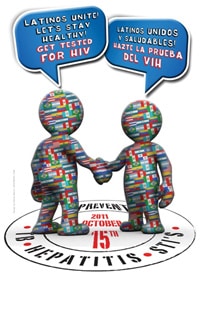
This year's theme—Latinos Unite! Let's Stay Healthy! Get Tested for HIV!—speaks to the critical role Latino community members play in supporting HIV testing and prevention education, which saves lives. We can promote healthy communities by facilitating partnerships; hosting community events that encourage people to seek HIV testing, counseling, and treatment; and by developing and disseminating prevention strategies that are culturally competent and accessible.

The Centers for Disease Control and Prevention (CDC) recommends that all adolescents and adults be tested for HIV as a routine part of medical care – regardless of perceived risk. Yet more than a half of Latinos have never been tested. It's critical to know your HIV status so you can take steps to protect yourself and sexual partner(s).

What Latino Communities Can Do

Graphic: Latinos Unite! Let's stay healthy! Get tested for HIV. October 15th, 2011

Individuals can

  • Get tested to find out if they are HIV positive.
  • Seek early medical care if they have HIV to protect their own and their partners' health.
  • Protect themselves and others from HIV through safer sex practices, not using or injecting drugs, and not sharing needles if they inject drugs.
  • Educate themselves and others about HIV.
  • Get involved in their communities to help prevent HIV or provide services to those in need.

Organizations are encouraged to

  • Promote NLAAD within their organizations and their broader community. Organizations and agencies are getting involvedExternal Web Site Icon in support of NLAAD across the nation. HIV awareness and testing events will provide thousands of Hispanics/Latinos with the important information they need to protect their health, their loved ones, and to get involved.
  • Encourage employees to get involved in NLAAD activities.
  • Educate staff about HIV/AIDS.
  • Develop HIV/AIDS policies for the workplaceExternal Web Site Icon.

Contact The Arkansas Department of Health for more info at: www.healthy.arkansas.gov  Navigate to the HIV/STD/HEP C section where there is both spanish and english information provided by the Texas State Department of Health.


Friday, October 05, 2012

History COP 24/7 Style

National LGBTQ History Month: October 1-31
Do you know your history and Icons?


Truman Capote - Monday, October 8th


Truman Capote crFB “Failure is a condiment that gives success its flavor.”
Truman Capote is a critically acclaimed author best known for the novels “In Cold Blood” and “Breakfast at Tiffany’s.” [More]


Chris Colfer - Tuesday, October 9th


Chris Colfer cr “I’ve tried being other people and myself suits me the best.”Among the first openly gay teens to portray an out character on primetime TV, Chris Colfer is best known for his role on "Glee." [More]


Kate Clinton - Wednesday, October 10th


Kate Clinton crFB 2 “Coming out as a lesbian onstage is still a very political act; if it weren't, more women would do it.”
Kate Clinton is a political humorist with a gay and lesbian perspective. [More]


Ramon Cortines - Thursday, October 11th


Ramon Cortines cr FB “Success is knowing who you are. If you don’t like yourself, change.”
Ramon Cortines is a nationally respected educator who served as the superintendent of the nation's two largest school districts. [More]

Thursday, October 04, 2012

COP 24/7 Point to Point 2.0

Will the Mitt Romney Stand UP
The Which Way Did They Go Debate Mash UP

Did you see it? You know that event that was being promoted as the "mother of them all debates" that seemed to spit and sputter as POTUS appeared preoccupied and GOP candidate Romney running away with it by saying anything and everything he prepped for during his mock debates. Wow, what the hell was that and exactly what happened to President Obama's mojo is a mystery to me. Meanwhile, even though the talking heads assert and I have to begrudgingly agree that Romney was on his game, the real take away from this vantage point is "will the real Mitt please step forward?" Much of his rhetoric and verbiage was more vintage "etch-o-sketch" bluster that he has mastered to play to whatever or whoever it will listen to his positions. My mouth fell open several times as I kept wondering "where did that position come from or wow! has he said that before and then that all but threat to "fire" Big Bird and all those moochers at PBS, literally set my hair on fire. For those who know me, I've long let my locks fall away years ago!! But, the political throw down bounces on and President Obama tries to explain that "okie doke" move or was that the Muhammad Ali "Rope-a-dope" move that caused many of us to wonder "WTF." Of course the spin misters have all weighed in that it could have been a "do no harm" tactic juxtaposed to the now "new and improved" Romney who has been a "severe conservative, or skewing past positions, I love firing folks, those 48% that won't vote for me and now bi-curious Mitt with far a few details guy."

And so it goes and I'm not confused that if you continue to sift away the "blah, blah, blah" you'll be able to figure out which way you need to go this November 6...directly to the polls and vote like you life depends on it. Because it just might!  Check out 1.866.MYVOTE1 for information or contact your local agencies on polling places and early voting precincts. Another great gadget for helpful updates and info is: www.mytimetovote.com  which will give you a snapshot of all things Arkansas including rules, issues, district maps, links and direct election offices with addresses and phone numbers. Get involved and make your voice known!  Don't forget: Poll Hours: 7:30 AM-7:30 PM        
Your precinct is determined by where you live and the polling site is assigned by your county election commission. Most local newspapers publish a list of polling sites within a few days of an election. If you received a Voter ID card from your county clerk, it may show your precinct. You can also find your location online at www.voterview.org.


Tenth Annual AIDS Walk – Celebration of Life
 
Registration for the Annual AIDS Walk, November 10 starts at 10:00 a.m. and will begin at noon. You can register as an individual walker or as a team at  www.active.com/donate/araidswalk2012
 or you can email djtucker61@gmail.com for donation forms, fliers, team instructions or for more information call the foundation at 376-6299 Registration fee will include t shirt, entertainment, and lunch.

The group will also be giving away awards to the teams with the most walkers, the most money raised, the best overall banner, and the walker with the most money raised. Registration fee is $25 and $15 for students.

This year they are asking participants to donate some toiletry or personal hygiene products to be distributed to our clients through their CANS program.


13th Annual Walk for CommUNITY – Just Communities

Mark your calendar for this year’s Walk for CommUNITY on Sunday afternoon, November 4, 2012. For more information about the Walk or to learn about sponsorship opportunities, contact Kerri Michael Sernel at (501) 372-5129 or hit up http://www.arkansasjustcommunities.org/events/unity/
 
2012 Walk Chair Graham Rich, cited that last year’s Walk raised over $53,000 for JCA programs, smashing the record for our most successful Walk ever! Over 800 people, friends old and new, gathered for the Little Rock diversity activity at the River Market pavilions to enjoy food, music, fun, and fellowship. Over 60 teams represented schools, area businesses, civic and nonprofit groups, faith communities, families, and neighborhoods.
 
 
The HELP FAIR Update

At post time COP 24/7 reported that over a 100 individuals had passed through the September 28, AIDS Awareness Day event sponsored by STRILITE and The Living Affected Corporation respectively. As all the sorting and assessing was done post event, it appears that least 102 persons were screened for STD/HIV/AIDS commencing with approximately 200 in attendance for the first of its kind LGBTQ sponsored event in conjunction with funding from the Arkansas Department of Health Hep C HIV/AIDS Section. STRILITE is an official sub-grantee utilizing Awareness Day micro grants in order to produce this series of events.

Event organizers confirmed that 97 bags of free groceries were distributed, cell phone access information was available from both Cricket and Assurance Wireless, participants passed through the Department of Workforce Mobile Office which was on site throughout the day and individuals were able to confirm their voter registration or register to vote via a online portal. As a bonus, a cookout was held on the grounds of the First Presbyterian Church in which guest feasted on grilled chicken, hot dogs and hamburgers with the support of the management of TRAXS.

 Each participating vendor received a framed certificate of appreciation,waived vendor fees for participating and inclusion in all media including radio air play on Streetz 101.1
Plans are underway for HELP Fair 2.0 in recognition of World AIDS Day, December 1, 2012. Sponsorships, donations, volunteer opportunities, in-kind contributions and booth information is now available at 855-STRILITE or info@lacorponline.org 

COP 24/7 thanks organizers for allowing this medium to be a contributing partner and ongoing supporter of the HEFTE concept. We agree that "its amazing what we can do when we all work together." Watch this forum more the latest details and breaking news about the next outing. For more check out www.livingaffected.blogspot.com or call 379.8203.

Wednesday, October 03, 2012

Point to Point COP 24/7

Statement from HHS Secretary Kathleen Sebelius on Breast Cancer Awareness Month


In October, during National Breast Cancer Awareness Month, we remember those who have lost their lives to breast cancer, and those who are battling it now, by recommitting ourselves to their fight and spreading the word of the importance of prevention and early detection.
Despite significant advances in treatment and prevention, breast cancer remains the second leading cause of cancer death for women in the United States. However, because of the Affordable Care Act, it’s a new day for women’s health and the fight against breast cancer.
We know that the chance of successful treatment is highest when breast cancer is detected early. While not a perfect tool, mammogram screenings are key to early detection. But budgets are tight, and even moderate copays can deter many women from getting those important screenings.
Because of the Affordable Care Act – the health care law signed by President Obama two years ago – many private health plans and Medicare now cover mammograms and certain other preventive services with no copays or other out-of-pocket costs. This means that women can get the potentially life-saving services they need to detect breast cancer before it spreads, without worrying how a copay would affect their family budget. Last year, more than 6 million women with Medicare got a free mammogram.
Under the health care law, other services to help prevent breast cancer are also covered, such as a well-woman visit – at no additional cost– so women have the opportunity to talk to their doctor about their health care needs, their personal risk for breast cancer, and their best options to reduce their risk. The Affordable Care Act gives women, not insurance companies or the government, control over their health care.
Women also have new rights and protections under the law against insurance company abuse. If diagnosed with breast cancer or another illness, women cannot have their coverage taken away when they need it the most simply because of a mistake made on paperwork. And beginning in 2014, it will be illegal for insurers to discriminate against anyone with a pre-existing condition, such as breast cancer.
The health reform law is also helping women who are going through costly breast cancer treatment by preventing insurance companies from imposing lifetime dollar caps on coverage. This means that women fighting breast cancer can focus on their health, their families, and living their lives, and not worrying that their insurance will run out while they still need treatment.
We have made substantial progress in reducing the burden and toll of breast cancer on American women and their families. Initiatives under the Affordable Care Act, along with ongoing research, are making real differences in the lives of American women and their families.

Secretary’s Minority AIDS Initiative Fund Supports $14.2 Million in Awards to 8 States to Improve HIV Testing and Engagement in Care


Dr. Ronald Valdiserri
Ronald ValdiserriThe CDC announced that eight state health departments have been awarded a total of $14.2 million in first-year funding under a new, innovative, three-year cross-HHS demonstration project aligned with the National HIV/AIDS Strategy (NHAS). The eight states – Georgia, Illinois, Louisiana, Mississippi, Missouri, North Carolina, Tennessee, and Virginia – have a high burden of HIV among African-Americans and Latinos and the demonstration project is designed to reduce HIV-related morbidity, mortality, and related health disparities among racial and ethnic minorities by addressing social, economic, clinical and structural factors influencing HIV health outcomes.

“This new program funding represents a carefully planned movement that specifically joins together HIV prevention and treatment into a holistic statewide continuum of service. That is what people with HIV need and it is what we intend to deliver,” observed Dr. Jonathan Mermin, Director of CDC’s Division of HIV/AIDS Prevention
The Care and Prevention in the United States (CAPUS) Demonstration Project was open to 18 state/territorial health departments in the United States with disproportionately high burdens of HIV/AIDS among minority communities. Specifically, the eligible jurisdictions had more than 5,000 HIV cases among African Americans and Latinos and an AIDS diagnosis rate of over 6 per 100,000, which focuses this initiative on disproportionately affected geographic areas.

The primary goals of the project are three-fold:
  1. Increase the proportion of racial/ethnic minorities with HIV who have diagnosed infection by expanding and improving HIV testing capacity
  2. Optimize linkage to, retention in, and re-engagement with care and prevention services for newly diagnosed and previously diagnosed racial/ethnic minorities with HIV
  3. Address social, economic, clinical, and structural factors influencing HIV health outcomes
The demonstration project is funded by the Secretary’s Minority AIDS Initiative Fund (SMAIF), which is administered by my office, the Office of HIV/AIDS and Infectious Disease Policy (OHAIDP). (Read my earlier blog post about how the rest of the Fiscal Year 2012 SMAIF was allocated.) In keeping with the spirit and goals of the NHAS, and in recognition of the complex, interrelated, and multi-sectorial nature of the demonstration project’s goals, a multi-agency federal partnership will provide leadership for the activities. CDC serves as the lead agency, with participation from OHAIDP, Office of Minority Health, Office on Women’s Health, HRSA’s HIV/AIDS Bureau and Bureau of Primary Health Care, and the Substance Abuse and Mental Health Services Administration.

By concentrating these resources in communities that bear a disproportionate burden, providing assistance from multiple HHS agencies and offices, and requiring the grantees to use a minimum of 25% of the total award to fund community-based organizations serving racial/ethnic minority populations, we expect that the CAPUS project will contribute significantly to NHAS goals over the next three years.

Over the coming year, we’ll share occasional updates and highlights from the CAPUS demonstration project. In the meantime, what interventions would you suggest that could improve HIV testing or engagement/retention in care among racial/ethnic minorities? Share your suggestions with us in our talk back section.
 

Tuesday, October 02, 2012

Leaning Forward and More

2012 U.S. Conference on AIDS – Highlights from Pre-Conference Summit to End the HIV/AIDS Epidemic in America


Dr. Ronald ValdiserriIn advance of the annual U.S. Conference on AIDS (USCA), approximately 150 people gathered in Las Vegas over the weekend for the Summit to End the HIV/AIDS Epidemic in America. The two-day event was organized by the National Minority AIDS Council Exit Disclaimer (NMAC), the host of USCA, and attended by executive directors of community-based organizations from across the country along with senior state and local health department staff, and several leaders from community health centers. Arkansas has representation at the conference from area agencies.
The Summit opened with presentations by Dr. Julio Montaner and Dr. Ron Valdiserri. They set the stage for the discussions that followed with important ideas about the implications of game-changing advances in our understanding of the benefits of biomedical prevention and some principles for achieving an AIDS-free generation.
Dr. Montaner, Professor of Medicine at the University of British Columbia and Director of the British Columbia Center for Excellence in HIV/AIDS Exit Disclaimer
Dr. Ronald Vadiserri. Photo credit: Ben Carter/NMAC.

 Exit Disclaimer, made the case that treatment as prevention is the key to an AIDS-free generation. Sharing the science behind the concept with examples from the experience of British Columbia, which has seen significant reductions in new HIV infections as they have scaled up HIV treatment efforts, he noted that the primary benefit of earlier HIV treatment initiation is the reduction of morbidity and mortality among people living with HIV. The well documented secondary benefit—the significant reduction HIV transmission as demonstrated by the HPTN 052 study and others—is not only huge, he argued, but also “free”. Achieving these benefits is not simple, Dr. Montaner acknowledged. The difficult part, he noted, is plugging the leaks in the treatment cascade so that a greater number of people living with HIV are linked to and retained in care, initiate antiretroviral treatment, and achieve a suppressed viral load. He shared the BC version of the cascade and observed candidly that we don’t yet know exactly how plug all of those leaks fully and well. But, he urged the participants to agree that the cascade serves as the best way to measure the success of HIV programs and should be used as the “standard report card for all of our programs.” He recognized important roles for community-based organizations in addressing the leaks in the cascade, noting that there is only so much that health care providers can do. Those roles include addressing HIV-related stigma, discrimination and, in some cases, criminalization that complicate efforts to prevent, diagnose and treat HIV. He also cited the important role of CBO support of patient navigation activities.

Signing the Declaration to End AIDSDr. Valdiserri, Deputy Assistant Secretary for Health, Infectious Diseases, and Director, Office of HIV/AIDS and Infectious Disease Policy at the U.S. Department of Health and Human Services, discussed several principles for achieving an AIDS-free generation. He illustrated each principle with examples from recent HIV research and in so doing highlighted possible approaches for community based organizations and other partners to examine as they work to assess and, possibly, re-tool their
Photo credit: Ben Carter/NMAC
 
roles in helping to end HIV/AIDS in America. Among the principles he shared was “Engage communities in finding solutions to HIV/AIDS.” To illustrate the principle, he discussed highlights from two studies demonstrating the efficacy of community-based, non-clinical approaches to improving HIV care access and treatment adherence. Echoing, in part, Dr. Montaner’s call, another principle articulated by Dr. Valdiserri was “Engineer systems to incorporate emerging research findings.” On this, he quoted NMAC’s Executive Director, Mr. Paul Kawata who has said, “It’s time to adapt…HIV prevention is changing…CBOs must change their service models to adapt.” Dr. Valdiserri noted that it is not only CBOs that must adapt, but all of the systems involved in the response to HIV – federal, state and local governments, clinical care settings, and others – all need to make changes to adapt to significant recent scientific advances in HIV prevention and treatment.
The Summit also featured the release of the “Declaration to END HIV/AIDS in America Exit Disclaimer.” NMAC facilitated development of the Declaration by convening a blue ribbon panel, which included representatives from more than 100 community‐based, public, and private organizations as well as governmental leaders and people living with HIV/AIDS. The Declaration discusses how to translate groundbreaking policy and science developments into an end to HIV/AIDS. Dr. Benny Primm, a founder and Chair Emeritus of NMAC, invited the participants to sign the declaration, rededicating themselves to the mission of ending HIV/AIDS in America and to implement that commitment through all they do when they return to work at their organizations following USCA.

Over the remainder of the two-day Summit, the participants heard from a number of other thought leaders on key topics: HIV testing and diagnosis; linkage and access to care; retention in care; and treatment. The HIV leaders from across the country participating in the Summit held several rounds of intensive, in-depth small group conversations to unpack what the thought leaders were sharing and discus their own experiences and concerns as they reflected on how they and their organizations will move forward in revitalized ways to better serve their communities and help bring us closer to ending HIV/AIDS in America.

Check back with the AIDS.gov blog later today. We’ll be posting highlights from Sunday’s USCA opening day plenary sessions; and tomorrow we’ll share highlights from the second day of the conference.